

&me Anti Stigma Campaign
A campaign to encourage senior, currently well healthcare professionals including doctors, vets, dentists and pharmacists to informally self identify as having experienced a mental health condition in order to reduce the stigma of mental health in the healthcare professions.
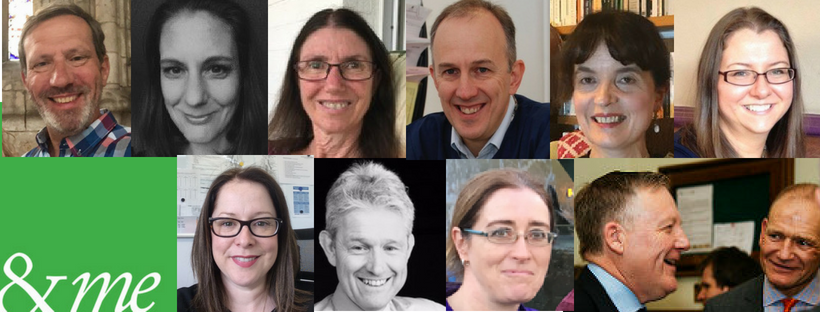

Our inspiring &me volunteers
List of services
-
Vet Kirstie Pickles
Vet Kirstie Pickles frankly discusses her experience of anxiety and depression as well as her recent diagnosis of autism. 'I am very open about being autistic, both to help myself stay well and reduce my triggers and also to encourage other people that it is ok.'
-
Vet James Glass
Vet James Glass was diagnosed with severe depressive disorder in 2018 and was off work for nine months. James writes: 'Life is absolutely worth living again and, while I might not have chosen this pathway, it’s a privilege to use my experience to help others.'
-
Vet Ebony Escalona
'The manic highs can often be part of great things such as founding Vets Stay Go Diversify. They remind me that I’m beautifully human and I’m not a robot and that big mental health moments have acted as important pivot points for me to reevaluate what I want to do and why. Be them in the phases of my hypomania or my depression.'
-
Dr Serena Haywood, consultant paediatrician
On the aftermath of a traumatic work experience:
'The fear and isolation of this event led me to take the risky decision to start talking about my mental health as much as I could to as many people as would listen. I was advised not to but did it anyway. And my life changed from there. '
-
Caroline Elton, occupational psychologist & author of 'Also Human'List Item 1
'I don’t want to collude with the fantasy that depression, or any other mental illness, only happens to other people. It has certainly happened to me.'
-
Vet Nurse Meghan Conroy
'My mental health is a part of me, but it does not define me. Certainly not as a nurse.'
-
Vet Allisdhair McNaull
'It was at this time I realised that I needed help. It had only taken me 25 years to come to this realisation.'
-
Dr Becky Hirst, consultant palliative medicineList Item 2
'I wouldn’t wish the experience on anyone, but I could not have gained such insights into the world and myself without it. Depression leaves a stain on your soul, even when you fully recover, but that scar serves to remind me of the journey I’ve made and be grateful.'
-
Vet Stephanie WalshList Item 3
'Hopefully by sharing my story, we can work to reduce the stigma, and open early channels of communication to help look after the mental health of ourselves and others.'
-
Dr Rebecca Lawrence, consultant psychiatristList Item 4
'Adapt if you need to because of the illness, but never because of the stigma of the illness, whether self-stigma or otherwise.'
-
Vet Steve Carter
'The single most important realisation for me was that I am always going to be vulnerable and it was necessary to come to terms with that “weakness” whether I liked the idea or not.'
-
Dr Cathy Wield, emergency medicine doctor
Cathy is passionate about speaking out and reducing the stigma around mental health.
'There is still a long way to go to eliminate not only the stigma of current mental illness, but also of the past. While I worked in A&E until August last year, I did my utmost to be open about myself and to educate my colleagues.'
-
Prof. Jamie Hacker Hughes, psychologist
Jamie says that it is really important that people at the top of the profession speak openly about the fact that they are human too!
-
Vet Rob Pettitt
'We would not hesitate to tell people if we broke a bone; the same should apply to mental health.
What surprised me was the number of people who have been affected and you will always find someone who has been there – support from others is invaluable in those difficult times so you do not have to suffer alone.'
-
Dr Susan Atcheson, general practitioner
'Stigma can be addressed and challenged but this work needs recognition, involvement and reinforcement. We all have to take part.
For my part "My name is Susan, I am a senior GP and I have a history of depression".'
-
Dr Malcolm Kinnear, consultant psychiatrist
Malcolm finds that having taken some of the medications he now prescribes can be rather helpful in terms of understanding their effects!
-
Dr Caroline Walker, psychiatrist & psychotherapist
'The worst stigma I've experienced over the years was the stigma I put on myself.
Speaking out about my illness has helped me to feel less ashamed - I now feel incredibly proud of my experiences and the way I manage my mental health.'
-
Dr Angelika Luehrs, consultant psychiatrist
'When I asked for advice about how to access help one of the answers I got was one of ‘whatever you do, make sure that you don't have any mental illness in your medical records otherwise you will never go anywhere in your medical career'.
However, getting the diagnosis (bipolar affective disorder) and help from a Consultant Psychiatrist was the best thing that ever happened.'
-
Vet David Bartram
'My episode of mental ill-health by no means defines me but it’s an important part of me and, although I would not wish it upon anyone, I think it has changed me in a positive way, both personally and professionally.'
-
Dr Jonathan Richardson, consultant psychiatrist & medical director
'It is 24 years since my mental illness. I now work in Northumberland, Tyne and Wear NHS Foundation Trust, one of the largest mental health and learning disability trusts in England – and one of only two to be rated outstanding by the Care Quality Commission…. I do not feel that my illness has stopped me.'
-
Dr Louise Freeman
'When I was sick, I was told that a colleague had ‘always thought that I was a mental health problem waiting to happen.’
On reflection, yes that was true, but only in as much as this applies to ALL of us during our lives.'
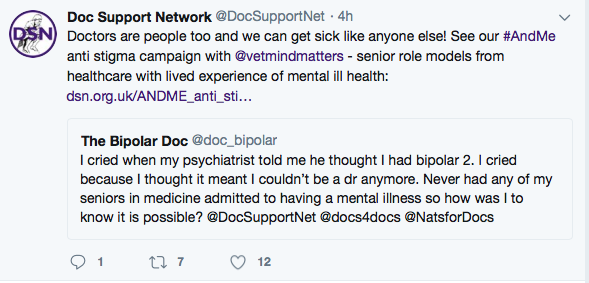
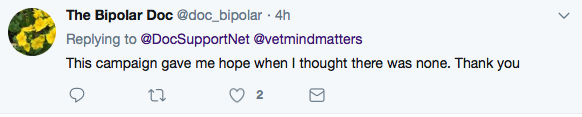
Our campaign made a huge difference for health professionals - see responses below from
@TheBipolarDoc on Twitter:
Author and psychiatrist Dr Linda Gask speaking about &me and her recent Guardian column
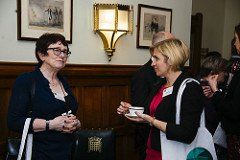
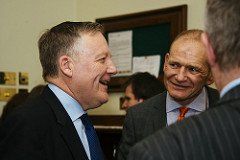
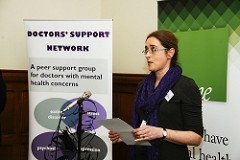
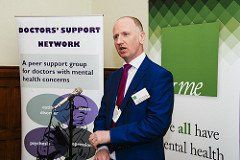
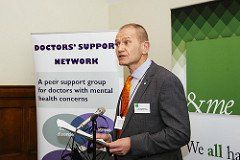
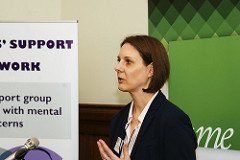
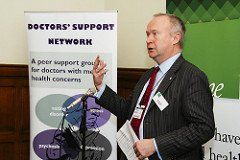
&me launch at House of Commons Tuesday 31st January 2017

&me Anti Stigma Campaign Outline
What we know
The annual incidence of mental health disorder in the UK population as a whole is that 1 in 4 people in any 1 year will suffer a mental health problem and the lifetime incidence is closer to 1 in 2. Healthcare professional groups are at even higher risk than the general population. For example, doctors are at relatively higher risk of suicide than non medics and vets have quadruple the suicide risk of the general population. A recent survey showed GPs to be 3 times more likely to be depressed than the general population - but there are well-identified barriers to healthcare professionals seeking support and treatment when they are unwell with a mental health problem.
A major factor is the potential stigma and worry about subsequent detrimental career effects. Stigma was noted to be a factor in the events leading to the tragic deaths of psychiatrist Daksha Emson and her baby daughter Freya . Reluctance to seek help can contribute to sickness absence, and reduced staff retention as well as the presenteeism effect where staff are at work but do not function optimally due to their ill health – highlighted in the 2009 Boorman review .
What about the General Medical Council (GMC) / regulatory bodies?
The potential intervention of regulatory bodies such as the GMC can affect practitioners’ willingness to seek help for mental health issues. In reality, GMC guidance is that there is no need for the GMC to be informed about an individual doctor’s mental health diagnosis unless there is a risk to patient safety, for example due to the doctor refusing to follow the advice of their own medical advisors.
Would healthcare professionals currently unwell with a mental health problem be expected to ‘out’ themselves?
Definitely not. The campaign specifically does not wish to risk increasing unwell professionals’ concerns about stigma or breach of confidentiality as this would be likely to lead to reluctance to seek help.
How will the &me campaign help?
Healthcare organisations such as regulatory bodies and colleges are united in urging individual practitioners to seek help if they are unwell with a mental health problem and reassuring them that this is normal. There is a marked absence of leaders within the healthcare professions who have admitted to themselves having been affected by a mental health problem. The effect of this combination is that healthcare professionals, with a mental health problem, can feel as if only they have had a problem and that successful people in their chosen field have not. This is not true but can act as a significant barrier to help seeking behaviour from affected healthcare professionals.
The idea of the campaign is for a group of senior, currently well health care professionals to self identify as having previously been unwell with a mental health problem and that this has not prevented them from succeeding in their chosen field. And doctors seem to have more of a problem in admitting to their own mental health issues than other healthcare professionals. We would suggest that if doctors could improve their approach to their own mental health, this would be likely to lead to better medical care for everyone (patients) with mental health problems.
We hope that this campaign will add to the overall anti stigma message of campaigns such as ‘
Time to Change ’.
Partners for the &me campaign
- Northumberland, Tyne and Wear NHS Foundation Trust – NTW is a major mental health trust in the North of England. Chief executive John Lawlor is open about his own history of depression. The trust has recently been involved in the ‘ Time to Talk ’ campaign from ‘ Time to Change ’.
- Royal College of Psychiatrists – previously ran the ‘ Changing Minds ’ campaign and its president Professor Sir Simon Wessely is particularly interested in stigma.
Campaign
The &me campaign will be launched at the House of Commons on Tuesday 31st January at an afternoon tea event kindly sponsored by Kevan Jones MP . Kevan is open about his own history of depression and has done much excellent work in this area. Senior volunteers from within the professions will talk briefly about their experiences and there will be an opportunity for networking.
The campaign will feature volunteer senior role models via website and social media posts using the hashtag '#AndMe' .
